Best SEO Experts in Kenya
Home » Digital Marketing Blog-Industry News » SEO vs Performance Marketing: Which Delivers Better ROI for Your Business?
SEO vs Performance Marketing: Which Delivers Better ROI for Your Business?
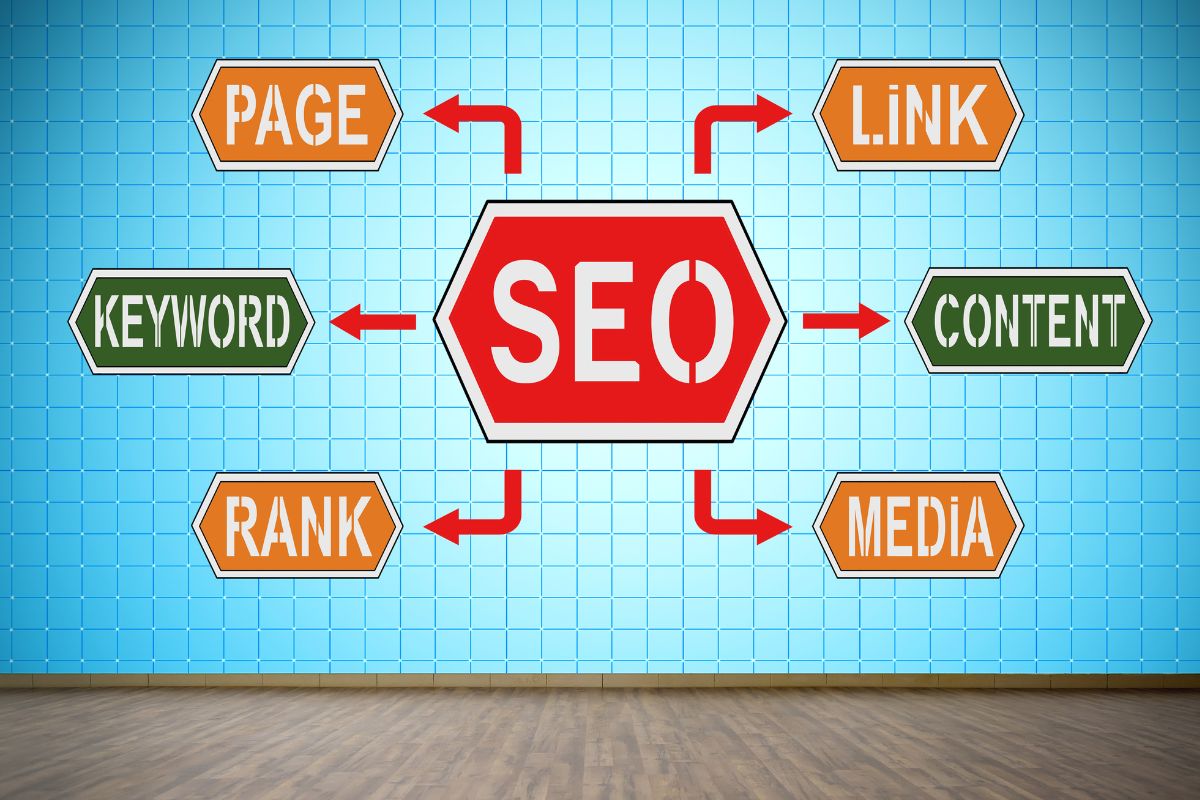
Businesses today are divided between two powerful growth approaches: organic search optimization (SEO), which builds long-term visibility on Google, and performance marketing, which focuses on paid, measurable campaigns that drive immediate results. Both strategies play a major role in digital growth, but they work in very different ways when it comes to cost, speed, and scalability. Understanding SEO vs performance marketing is essential for identifying which approach delivers better ROI based on your goals, whether you want traffic, leads, or direct sales.

Corporate Digital Marketing Training

Overview of Contents

What is SEO?

SEO (Search Engine Optimization) is the process of improving a website so it ranks higher on search engines like Google without paying for clicks. It focuses on optimizing content, website structure, keywords, and technical performance so that search engines can easily understand and recommend your pages to users searching for relevant information. Unlike paid ads, SEO generates organic traffic that grows over time as your website gains visibility and trust.

At its core, SEO is a long-term strategy built on creating valuable content, building website authority, and improving user experience. As your pages rank higher, your business attracts consistent, high-quality traffic without ongoing advertising costs, making it a powerful foundation for sustainable online growth.

What is Performance Marketing?

Performance marketing is a form of paid, data-driven advertising where businesses only pay when specific, measurable actions occur, such as clicks, leads, or conversions. It focuses on delivering results that can be tracked in real time, allowing businesses to clearly see what is working and what is not. This makes it a highly accountable approach to digital marketing compared to traditional advertising methods.

performance marketing trends 2026 (3)

The strength of performance marketing lies in its speed and optimization capabilities, as campaigns can be adjusted instantly based on performance data. By continuously tracking metrics like ROAS, CPA, and conversion rates, businesses can refine targeting, improve ad creatives, and maximize return on investment with precision.

Key Differences Between SEO and Performance Marketing

SEO and performance marketing serve the same purpose of driving business growth, but they operate in very different ways in terms of cost, speed, and scalability. Understanding these differences in SEO vs performance marketing helps businesses choose the right strategy based on their goals, budget, and expected timeline for results:

1. Cost Structure

SEO is a long-term investment that requires consistent effort in content creation, optimization, and authority building over time. Performance marketing, on the other hand, is pay-per-result, meaning businesses pay for actions like clicks, leads, or conversions.

2. Speed of Results

SEO typically takes time to build rankings and authority, so results are slower but more sustainable. Performance marketing delivers fast results since campaigns start generating traffic and conversions almost immediately after launch.

3. Traffic Type

SEO drives organic traffic from search engines without direct advertising costs per click. Performance marketing generates paid, highly targeted traffic based on audience segmentation and campaign targeting.

4. Measurability

SEO results are often tracked indirectly through rankings, organic traffic growth, and engagement metrics. Performance marketing provides real-time, detailed tracking of every click, lead, and conversion, making optimization more precise.

5. Scalability

SEO growth is gradual and depends on content quality, authority, and competition levels. Performance marketing is highly scalable with budget, allowing businesses to increase reach and conversions quickly by increasing ad spend.

SEO vs Performance Marketing – Which Delivers Better ROI?

The answer to SEO vs performance marketing in terms of ROI is not one-size-fits-all, because return on investment depends heavily on a business’s goals, timeline, and available budget. SEO often delivers stronger long-term ROI as it builds organic traffic that continues without ongoing ad spend, while performance marketing generates faster, more immediate returns by driving paid traffic that can be optimized in real time. The real difference lies in how quickly you need results and how sustainably you want to scale growth.

1. Short-Term ROI: Performance Marketing Advantage

Performance marketing delivers faster ROI because campaigns can start generating traffic, leads, and sales almost immediately after launch. This makes it ideal for businesses that need quick revenue, product testing, or rapid scaling.

2. Long-Term ROI: SEO Compounding Effect

SEO builds ROI gradually but powerfully over time as rankings improve and organic traffic accumulates without paying per click. Once established, it continues generating leads and sales at a lower ongoing cost.

3. Cost Efficiency Over Time

SEO becomes more cost-efficient in the long run since content and rankings continue to generate traffic without continuous ad spend. Performance marketing requires ongoing budget allocation to maintain results.

4. Scalability of Results

Performance marketing scales quickly by increasing budget and expanding campaigns. SEO scales more slowly as it depends on content creation, authority building, and search engine ranking improvements.

5. Predictability of Returns

Performance marketing offers more predictable short-term outcomes due to real-time tracking and optimization. SEO results are less predictable in the short term but become stable once rankings are established.

6. Best ROI Strategy: Combined Approach

The highest ROI is often achieved when both strategies are used together. Performance marketing drives immediate sales, while SEO builds long-term organic growth, creating a balanced and sustainable revenue system.

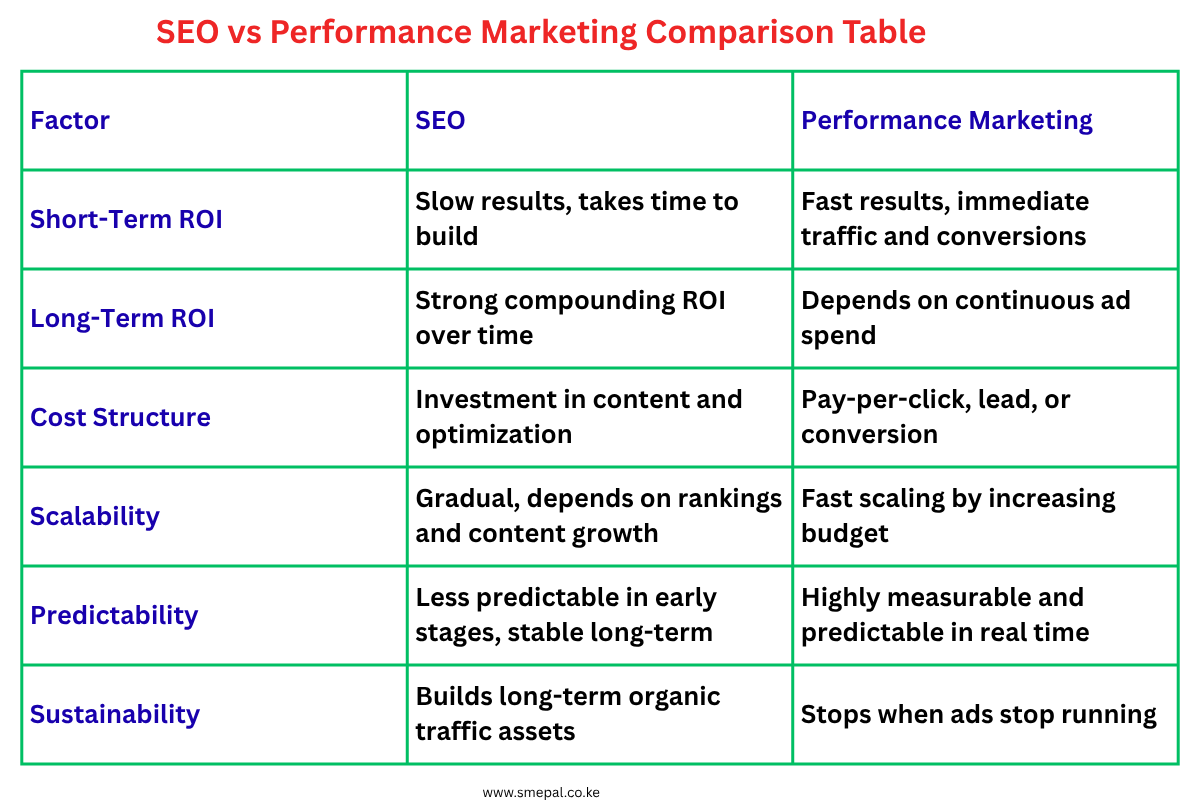
SEO vs Performance Marketing Comparison Table


When SEO is the Better Choice

In the SEO vs performance marketing decision, SEO is the better choice when a business is focused on long-term visibility, authority building, and sustainable organic traffic without heavy reliance on paid ads. It works best in situations where growth is gradual but consistent, and where the goal is to build a strong digital foundation over time. SEO becomes especially valuable when businesses want compounding results that continue delivering value long after the initial effort.

1. Long-Term Brand Building

SEO is ideal for long-term brand building because it helps businesses establish trust, authority, and consistent visibility in search results. Over time, strong rankings and quality content position a brand as an industry leader.

2. Content-Heavy Industries

SEO works best in content-heavy industries such as blogs, SaaS, education, and service-based businesses where users actively search for information. These businesses can attract continuous traffic by consistently publishing optimized, valuable content.

3. Low Ad Budget Strategies

SEO is the preferred option for businesses with limited advertising budgets since it does not require ongoing payments for clicks or impressions. Although it takes time to show results, it provides a cost-effective and sustainable growth channel in the SEO vs performance marketing landscape.

4. Building Long-Term Organic Traffic

SEO is ideal when a business wants to build consistent organic traffic that grows over time without depending on daily ad spend. Once rankings improve, traffic continues flowing even with minimal ongoing investment.

5. Establishing Authority and Trust

SEO helps businesses establish credibility by ranking high on search engines for relevant queries. Higher visibility in search results builds trust with users who often perceive top-ranking websites as more reliable.

6. Reducing Long-Term Customer Acquisition Costs

SEO is the better choice when the goal is to reduce long-term customer acquisition costs. Unlike paid ads that require continuous spending, SEO generates ongoing traffic and leads without paying for every click.
When Performance Marketing is the Better Choice

In the SEO vs performance marketing comparison, performance marketing becomes the stronger choice when a business needs fast, measurable, and scalable results. It is designed to deliver immediate visibility, trackable conversions, and real-time optimization, making it ideal for businesses that cannot wait months to see returns. This approach works best when speed, control, and direct revenue generation are top priorities:

1. Immediate Sales Needed

Performance marketing is the best option when a business needs quick sales or fast cash flow. Paid campaigns can start generating traffic, leads, and conversions almost immediately after launch, making it ideal for urgent revenue goals.

2. E-commerce Growth

E-commerce businesses benefit greatly from performance marketing because it directly targets buyers with high purchase intent. Platforms like Google, Meta, and TikTok help drive product sales, abandoned cart recovery, and scalable revenue growth.

3. Lead Generation Campaigns

Performance marketing is highly effective for generating qualified leads through targeted ads and optimized landing pages. Businesses can capture user data in real time and nurture prospects into paying customers through structured funnels.

4. Scaling Quickly

When rapid business expansion is required, performance marketing allows fast scaling by increasing ad budgets and expanding targeting. This makes it easier to test, optimize, and grow campaigns based on real performance data.

5. Highly Targeted Customer Acquisition

Performance marketing is ideal when a business needs to reach specific audiences based on demographics, interests, behavior, or purchase intent. This precision targeting ensures that ad spend is focused only on users most likely to convert.

6. Real-Time Performance Optimization

Performance marketing is the better choice when continuous tracking and optimization are required. Businesses can monitor ROAS, CTR, CPA, and conversions in real time, allowing quick adjustments that improve campaign performance and profitability.

Why the Best Strategy is a Combination of SEO and Performance Marketing

In the SEO vs performance marketing discussion, the most effective approach is not choosing one over the other, but combining both into a unified growth system. SEO and performance marketing work at different stages of the customer journey, and when integrated properly, they create a full-funnel strategy that balances long-term visibility with immediate results. This combination helps businesses maximize reach, conversions, and overall return on investment.

1. SEO Builds Long-Term Trust and Authority

SEO helps businesses establish credibility by ranking organically on search engines for relevant keywords. Over time, this consistent visibility builds trust with users and drives steady, long-term traffic without ongoing ad spend.

2. Performance Marketing Drives Fast Conversions

Performance marketing delivers immediate traffic and conversions through targeted paid campaigns. It ensures businesses can generate sales quickly while testing offers, products, and audiences in real time.

3. SEO Supports Awareness Stage Traffic

SEO attracts users who are searching for information, solutions, or comparisons, making it ideal for the awareness stage of the funnel. This helps introduce the brand to potential customers early in their decision-making journey.

4. Performance Marketing Captures High-Intent Buyers

Performance marketing focuses on users who are ready to take action, such as clicking, signing up, or purchasing. This makes it highly effective for converting traffic into actual revenue.

5. Combined Strategy Reduces Customer Acquisition Costs

When SEO starts generating organic traffic, businesses become less dependent on paid ads over time. This balance helps reduce overall customer acquisition costs while maintaining consistent lead flow.

6. Full-Funnel Growth System for Scalability

Using both strategies together creates a complete marketing ecosystem where SEO drives awareness and trust, while performance marketing accelerates conversions and scaling. This integrated approach ensures sustainable growth, better ROI, and consistent business performance.

Common Mistakes Businesses Make When Choosing Between SEO and Performance Marketing

Many businesses struggle in the SEO vs performance marketing decision not because the strategies are ineffective, but because they are applied incorrectly or without clear planning. Choosing the right approach requires understanding timing, goals, and execution, and mistakes in this process often lead to wasted budget, slow growth, or poor ROI. Below are the most common mistakes businesses make:

1. Relying on Only One Strategy

Many businesses depend entirely on either SEO or performance marketing instead of combining both. This limits growth potential and reduces overall marketing efficiency.

2. Expecting SEO to Deliver Fast Results

SEO takes time to build authority and rankings, but many businesses expect immediate traffic and sales. This leads to frustration and premature abandonment of a strong long-term strategy.

3. Running Ads Without Optimization

Performance marketing requires continuous tracking and optimization, but some businesses run ads without improving targeting or creatives. This results in high spend and low returns.

4. Ignoring Content Strategy

SEO depends heavily on quality content, yet many businesses fail to create valuable, optimized content. Without it, ranking and organic visibility become difficult to achieve.

5. Poor Tracking Setup

Without proper tracking tools like analytics and conversion pixels, businesses cannot measure performance accurately. This makes it impossible to optimize campaigns effectively.

6. Not Aligning Strategy with Business Goals

Choosing SEO or performance marketing without considering business objectives leads to misaligned efforts. Strategy should always match whether the goal is traffic, leads, or sales.

7. Over-Focusing on Traffic Instead of Conversions

Some businesses focus only on increasing website traffic without optimizing for conversions. High traffic without sales leads to poor ROI and wasted effort.

8. Poor Budget Allocation

Investing too much in one channel while neglecting the other can limit growth. A balanced allocation ensures both short-term and long-term performance.

9. Lack of Testing and Experimentation

Businesses often fail to test different ads, keywords, or content strategies. Without testing, it becomes difficult to identify what actually drives results.

10. Ignoring Customer Journey Alignment

SEO and performance marketing work at different stages of the funnel, but many businesses treat them separately. This disconnect reduces overall marketing effectiveness and conversion rates.

Why Choose Smepal Consultancy Agency Limited

Choosing the right digital partner in the SEO vs performance marketing landscape can determine whether your business grows steadily or struggles with inconsistent results. At Smepal Consultancy Agency Limited, we combine strategic SEO expertise with high-performing paid advertising systems to deliver a complete growth solution that focuses on visibility, leads, and measurable ROI.

1. Integrated SEO and Performance Marketing Expertise

We don’t treat SEO and performance marketing separately. Instead, we combine both strategies to create a unified system that drives both long-term organic growth and immediate paid conversions.

2. Data-Driven Decision Making

Every campaign we run is backed by real performance data. We continuously track, analyze, and optimize key metrics such as traffic, conversions, ROAS, and ROI to ensure consistent improvement.

3. Focus on Measurable Business Results

Our priority is not just traffic but real business outcomes such as leads, sales, and revenue growth. We design strategies that directly impact your bottom line.

4. Customized Strategies for Every Business

We understand that every business is different. That’s why we create tailored SEO and performance marketing strategies based on your industry, goals, and target audience.

5. Multi-Channel Growth Approach

We leverage Google, Meta, TikTok, and search engines to ensure your business reaches customers at every stage of the buying journey, from awareness to conversion.

6. Transparent Reporting and Communication

We provide clear, detailed reports so you always understand how your campaigns are performing and where your growth is coming from.

7. Proven Focus on ROI Optimization

Our strategies are built around maximizing return on investment. Whether through SEO or performance marketing, we focus on reducing wasted spend and increasing profitability.

With Smepal Consultancy Agency Limited, you get more than marketing services—you get a strategic partner committed to helping your business grow through both organic and paid digital success.

FAQs About SEO vs Performance Marketing

Understanding SEO vs performance marketing can be challenging for many businesses, especially when trying to decide which strategy delivers better results. Below are the most frequently asked questions to help clarify how each approach works and when to use them.

1. What is SEO vs performance marketing?

SEO vs performance marketing refers to the comparison between organic search optimization and paid, results-driven advertising. SEO focuses on ranking websites organically on search engines, while performance marketing focuses on paid campaigns that generate measurable actions like clicks, leads, and sales.

2. Which is better for ROI?

ROI depends on business goals and timeline. SEO delivers stronger long-term ROI through organic traffic, while performance marketing provides faster, more immediate returns through paid conversions.

3. Does SEO or ads bring faster results?

Performance marketing brings faster results because campaigns can generate traffic and sales immediately after launch. SEO takes longer as it requires time to build rankings and authority.

4. Can I use both together?

Yes, using both together is often the most effective strategy. SEO builds long-term visibility and trust, while performance marketing drives immediate traffic and conversions.

5. Is SEO cheaper than paid ads?

SEO is generally more cost-effective in the long run because it does not require payment for each click. However, it requires time and consistent effort before results are fully realized.

6. How long does SEO take?

SEO typically takes several months to show strong results depending on competition and industry. Once established, it can deliver consistent traffic and leads over time.

7. Which is better for e-commerce?

Performance marketing is often better for e-commerce because it drives immediate product sales and allows precise targeting. However, SEO also supports long-term organic traffic and brand visibility.

8. Do ads stop working when budget stops?

Yes, performance marketing results usually stop when the advertising budget is paused. Unlike SEO, paid ads require continuous investment to maintain traffic and conversions.

9. What is more scalable?

Performance marketing is more scalable in the short term because budgets can be increased to expand reach quickly. SEO scales gradually as content and rankings grow over time.

10. Which is best for small businesses?

Small businesses often benefit from a combination of both strategies. Performance marketing helps generate quick sales, while SEO builds long-term, sustainable growth.

Grow Your Business with Smepal Consultancy Agency Limited Today

Your business growth should not depend on guesswork when both SEO and performance marketing can be strategically aligned to deliver consistent results. At Smepal Consultancy Agency Limited, we help businesses build data-driven systems that increase visibility, generate qualified leads, and maximize ROI across both organic and paid channels. Contact us today for a personalized consultation and let us help you scale your business with a strategy that delivers both immediate and long-term growth.

Similar Posts